
AI-Driven Security & Productivity Solutions for Businesses
Access control quotes in South Africa can vary significantly, even for systems with the same number of access points, credential types, and controller setups. Depending on project scale, proposals can differ by tens of thousands, hundreds of thousands, or even millions of rands, making it hard to compare like-for-like.
The price gap often comes down to factors like authentication technology, hardware quality, locking mechanisms, and the level of ongoing support, details that aren’t always clearly outlined by suppliers.
This guide breaks down the key pricing factors for commercial and industrial access control systems. You’ll discover what drives costs per access point, how different provider models impact project pricing, and where savings can be made without compromising security. We also explore the long-term costs, including software licensing, maintenance, and future upgrades.
Before requesting your next quote, use this guide to ask more informed questions and identify any proposals that may be underspecified.
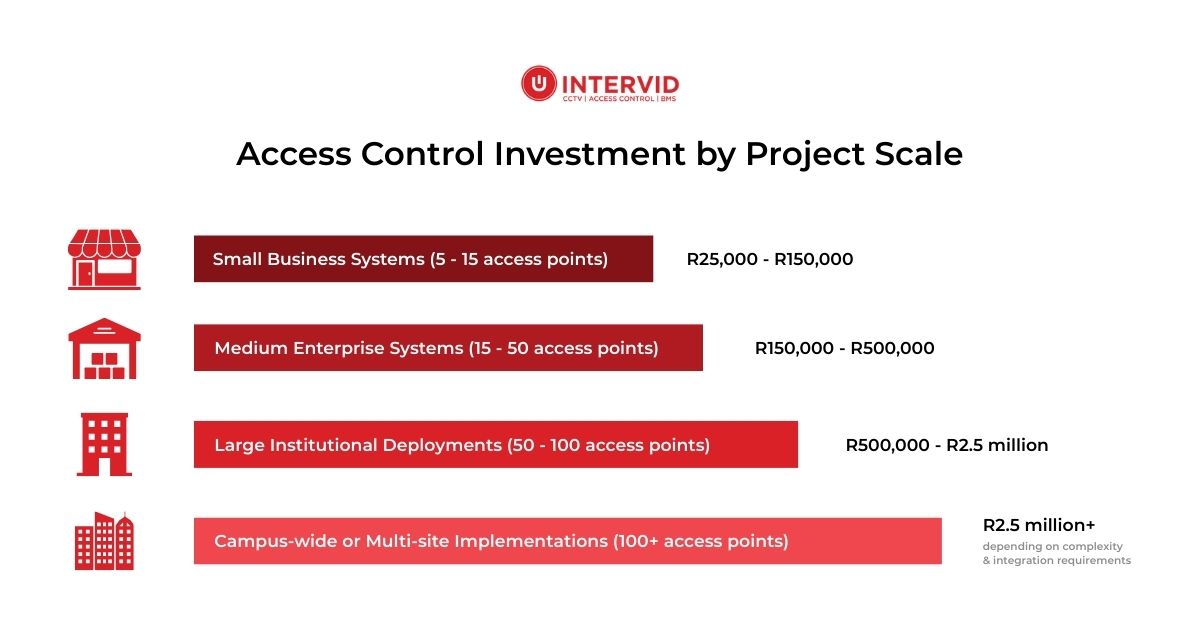
To give you a starting point, here’s what professional access control projects typically cost in South Africa:
These estimates cover hardware, professional installation, commissioning, and standard warranty.
Where you land within each range depends on a few things.
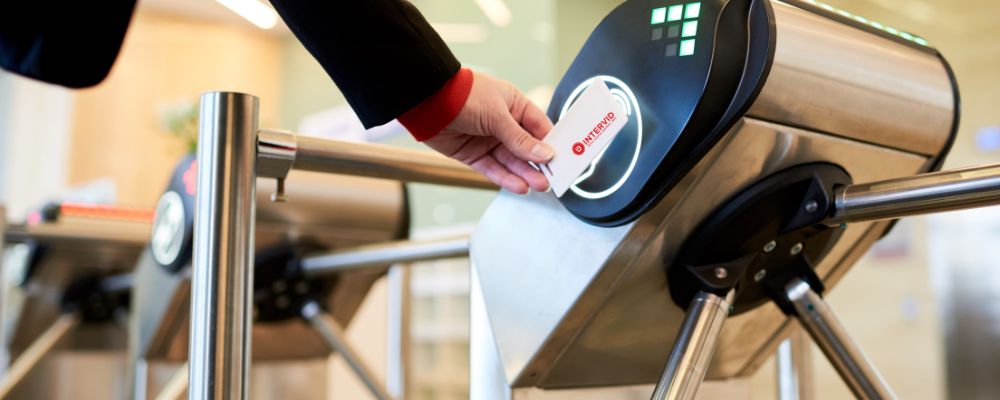
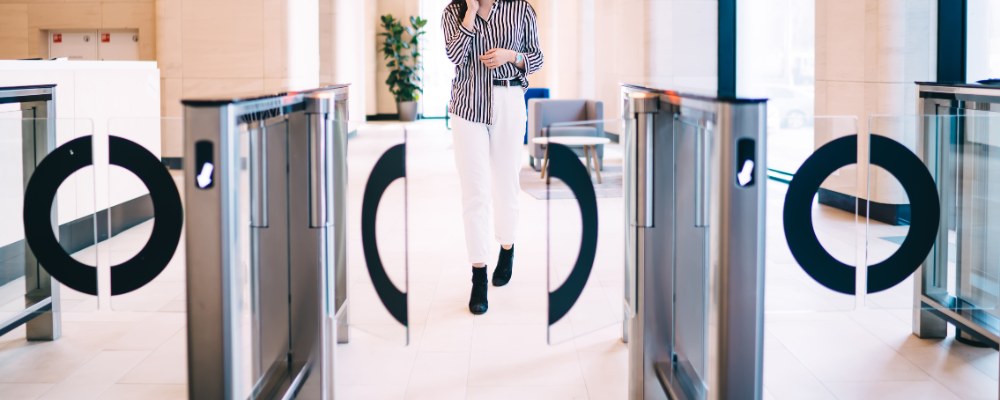
The type of access point makes a big difference. A standard door with a mag lock and card reader costs far less than a boom gate, turnstile, or biometric-secured entrance that requires specialised hardware and civil work.
Your choice of authentication technology also plays a role. Card and fob systems sit at the lower end, biometric access readers with anti-spoofing capabilities push costs higher, and enterprise platforms with multi-factor authentication and centralised site management sit at the top.
Other factors include integration with existing CCTV or building automation and management systems, site cabling conditions, and the level of ongoing support included in your agreement.
This guide unpacks each of these cost drivers in detail so you can evaluate quotes with confidence.
Need a clear picture of what your project will cost? Contact Intervid for a site assessment and tailored proposal.
Businesses and procurement teams struggle with access control quotes because suppliers rarely provide sufficient detail to compare solutions meaningfully.
One quote lists “20 doors with card readers”, while another specifies “biometric system with anti-spoofing and centralised management.” Both may cost the same, but deliver fundamentally different security capabilities.
Several key issues make commercial access control costs difficult to compare:
This lack of transparency leads to decisions based solely on initial pricing, only to discover the system lacks compliance features, remote management, or integration capabilities needed for effective operations.
Before comparing quotes, you need to understand which specifications genuinely impact security and which are filler. That’s what the following chapters break down.
Contact Intervid for a detailed access control assessment with transparent specifications and pricing.
A small office securing five doors has very different requirements to a mining operation managing blast zones, shift rotations, and perimeter breaches across a sprawling site. The system that protects one would be completely wrong for the other. Choosing the right tier starts with understanding what each offers, where it fits, and what it realistically costs in South Africa.
Standalone systems use basic proximity card readers or keypad controllers that operate independently without network connectivity. Each unit manages access at a single door or entry point using card, fob, or PIN code authentication.
These systems provide simple entry control with limited logging at the door level. You won’t get centralised management or detailed audit trails, but the functionality is adequate for basic access control at low-risk entry points.
Standalone systems are the most cost-effective option for small businesses with a handful of access points requiring basic theft deterrence. Installation is straightforward since the access control technology is simple and widely understood.
However, the lack of remote management means they suit single-location businesses with low staff turnover rather than facilities needing compliance documentation or centralised control. Shared PIN codes also create vulnerabilities, and cheaper units may need replacement within three to five years.
Network-based systems use Cat5e/Cat6 cabling with centralised management software, connecting all access points to a single administration platform. Multi-door controllers manage four to eight doors each, with electric strikes or magnetic locks and professional-grade power supplies with battery backup.
These systems deliver remote management from central workstations with detailed audit trails showing who accessed which point and when. User scheduling with time-zone restrictions, basic CCTV integration, and mobile credentials on some platforms provides professional security capabilities that scale as your business grows.
Network-based systems are the sweet spot for most commercial applications, suiting businesses with 5 to 50 access points that need compliance logs, instant permission adjustments, or multi-site expansion potential.
Quality installations typically deliver 8 to 15 years of operational life. The combination of professional features, scalability, and long-term reliability makes them suitable for growing businesses that will outgrow standalone systems quickly.
Biometric systems use fingerprint scanners, facial recognition cameras, iris readers, or palm vein technology with liveness detection for identity verification. Multi-factor configurations combine these with card or PIN authentication for layered security at high-risk entry points.
These systems eliminate credential sharing and buddy-punching entirely. Comprehensive audit trails provide forensic-level detail for compliance reporting, while real-time alerts flag unauthorised access attempts. Modern systems include POPIA compliance features protecting biometric data through encrypted template storage.
Biometric and facial recognition systems suit high-security facilities, data centres, pharmaceutical companies, laboratories, and financial institutions where absolute identity verification is non-negotiable. They’re particularly relevant for regulated industries where audit requirements go beyond what card-based systems can provide.
Basic fingerprint readers sit at the lower end of the range, while advanced facial recognition with AI-powered anti-spoofing and liveness detection commands premium pricing. User enrolment is required during implementation, and ongoing template management ensures continued recognition accuracy.
Integrated perimeter systems combine wide-area surveillance with access control at facility boundaries, using fence-mounted sensors, buried cable detection, microwave barriers, and AI-powered video analytics to create layered detection zones.
These systems detect intrusions before they reach buildings. When sensors activate, coordinated responses automatically direct cameras to breach locations, lock down access points, and trigger alerts across security management platforms. AI analytics distinguish genuine threats from false alarms caused by animals or environmental conditions.
Integrated perimeter security suits industrial facilities, mining operations, corporate campuses, distribution centres, and sites storing high-value assets or hazardous materials where regulatory compliance demands boundary protection.
Basic zone coverage with standard sensors falls at the lower end, while systems incorporating thermal imaging, long-range detection, and advanced AI analytics sit at the top. The investment reflects the engineering complexity of coordinating multiple security technologies into a single responsive system.

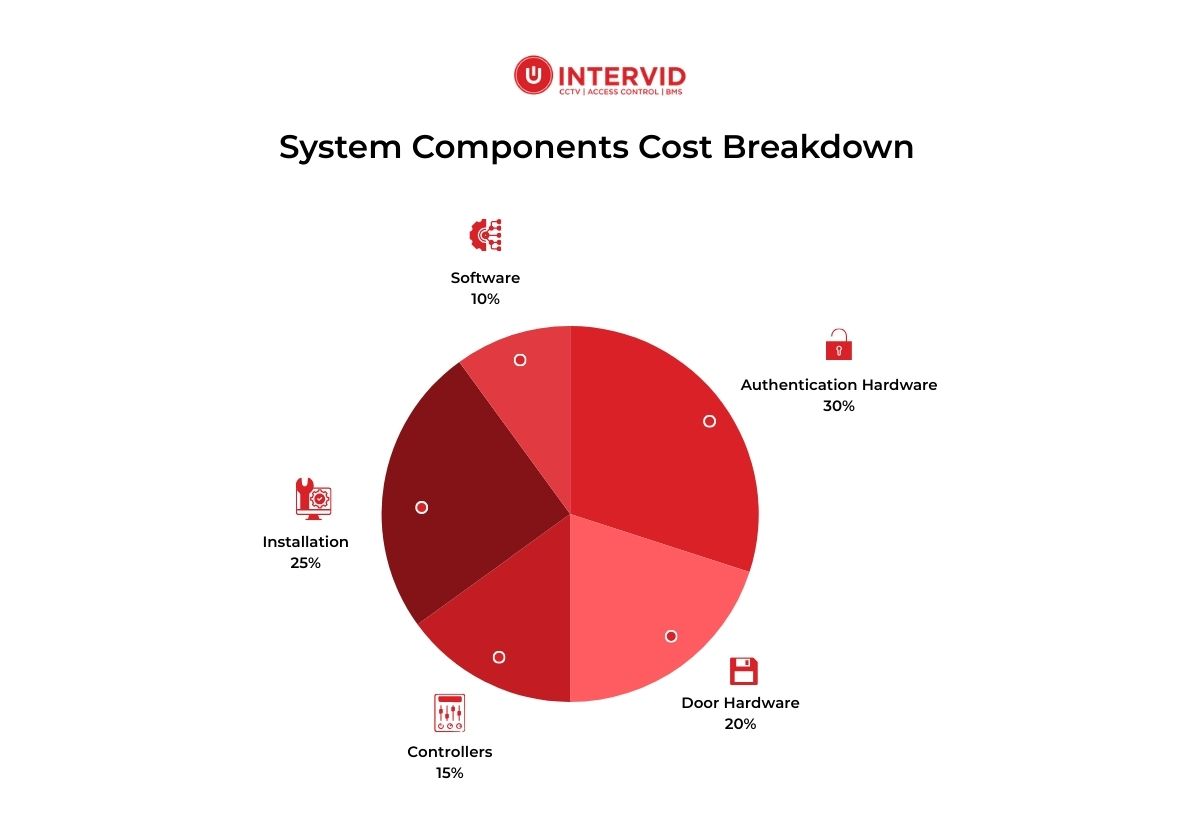
Commercial access control systems comprise several key components that work together to secure your facility. Each component represents a different portion of your total investment, with quality differences directly impacting both system performance and long-term reliability.
This chapter breaks down the main system components, their typical share of your budget, and how quality choices in each area affect your overall investment.
Authentication hardware typically represents 20-30% of your total system cost, ranging from basic card readers at around R1,500 to advanced biometric and facial recognition units exceeding R45,000.
The authentication method drives most of the price difference, with card and fob readers at the affordable end and multi-factor readers commanding the highest pricing. Environmental requirements also affect cost, with outdoor installations needing IP65-rated weatherproof enclosures that add 20-35% to reader costs.
The key is matching technology to actual security needs at each access point. A biometric reader at a server room entrance makes sense. The same reader at a general office door probably doesn’t.
Door hardware typically accounts for 20-25% of the total investment. This is where authentication decisions connect to physical security, and where cutting corners creates the most obvious vulnerabilities.
Electric strikes suit standard doors with existing locksets. Magnetic locks provide superior holding force for high-security applications and glass doors. Electrified panic hardware maintains fire code compliance on emergency exits while preventing unauthorised entry from outside.
What drives the cost here is compliance and integration. Fire alarm relays that release locks during emergencies are a regulatory requirement, not an optional extra. Request-to-exit sensors prevent false alarms, and door position switches catch propped-open conditions before they become security gaps.
Manual override mechanisms for power failures are essential for life safety. Skipping these components to reduce a quote is a red flag worth questioning.
Controllers typically account for 15-20% of system cost, sitting between your readers and locks to make authentication decisions.
System scale drives most of the variation. Per-door intelligent controllers suit small installations and continue operating during network failures. Centralised multi-door panels managing 4 to 32 doors reduce per-door costs for larger facilities. Advanced authentication methods require more powerful processing, which increases controller costs at higher system tiers.
Power supply and battery backup systems ensure continuous operation during outages, with commercial installations typically requiring 4 to 24 hours of backup capacity depending on facility criticality.
The controller tier should match your current scale with room for growth. Overspecifying wastes the budget, but underspecifying forces costly replacement when you expand.
Installation often represents the largest single cost component at 25-30% of total investment. This includes cabling, door preparation, hardware mounting, and skilled labour.
Cable run complexity drives much of the variation. Surface-mounted installations in accessible areas cost significantly less than concealed wiring through walls or underground conduit. Higher-bandwidth cabling is required for advanced authentication systems, while simpler setups use less demanding standards.
Door preparation, including drilling, reinforcement, and alignment, ensures proper operation and long-term integrity. Reader positioning requires careful attention to capture angles and lighting, particularly for biometric devices.
Integration wiring connecting access control with CCTV, alarms, and building management adds cost but delivers coordinated security responses.
Installation quality is where the gap between a budget quote and a professional quote becomes most apparent. Poor cabling creates reliability issues that surface months after the installer has been paid.
Software typically accounts for 10-15% of total investment, varying significantly between on-premise and cloud deployment models. On-premise requires upfront licensing, while cloud platforms charge monthly subscriptions covering storage, updates, and support.
Core software handles access control list administration, defining who accesses which points and when through complex schedules, temporary permissions, and role-based policies.
Real-time dashboards display door status, alarm conditions, and access events as they occur.
Reporting and audit trail systems document every access event for compliance and investigation. For regulated industries, this functionality isn’t optional, so ensure any system you evaluate meets your reporting requirements.
Mobile app access for administrators enables remote management, credential issuance, and emergency lockdown from smartphones. This is increasingly standard but still commands premium pricing on some platforms.
Not all cost increases are unjustified. Some reflect capabilities your facility genuinely needs, while others add little value for your specific situation. This chapter helps you determine which upgrades are worth paying for.
Basic card and fob systems are affordable and effective for standard commercial environments.
However, facilities handling sensitive data, hazardous materials, or regulated operations often require biometric or facial recognition authentication that commands significantly higher per-access-point pricing.
The premium reflects sophisticated hardware and processing requirements. Large user databases supporting thousands of employees increase costs through enterprise-grade controllers and expanded licensing. The infrastructure investment scales with organisational complexity.
For low-risk access points, advanced authentication may be unnecessary. But where a security breach carries regulatory, financial, or safety consequences, the enhanced verification justifies the premium.
The compliance requirements covered in Chapter Three legitimately increase project costs. Fire-rated door compliance requires certified installers and adds 30-50% to standard door hardware costs. Correct fail-safe and fail-secure configuration across different zones demands careful planning and coordination between trades.
The concern isn’t paying more for compliant work. It’s receiving a quote that doesn’t include it. A proposal that looks competitive but omits fire integration, egress testing, or commissioning may be missing essential compliance work rather than offering better value.
Enterprise-grade service agreements increase ongoing costs but provide support infrastructure that basic warranties cannot match.
Guaranteed response times ensure critical issues receive priority attention, typically within 2-4 hours for premium agreements compared to 24-48 hours for standard support. Where a failed access point halts operations or compromises security, that response gap carries real financial consequences.
Remote troubleshooting reduces downtime and callout fees. Preventive maintenance programs identify potential failures before they cause disruptions. While these commitments increase annual costs, they protect against the significantly higher expenses of emergency repairs and operational disruptions. Standard support may suit basic installations, but mission-critical facilities benefit from premium agreements.
Standalone installations serving a single building cost substantially less than multi-site deployments requiring centralised management platforms, enterprise licensing, and real-time credential synchronisation. Each additional site adds coordination, infrastructure, and configuration costs.
Integration with existing CCTV, fire detection, building management, or HR systems requires compatibility testing, custom configuration, and coordination between trades. Multiple authentication methods across different security zones multiply programming and validation requirements.
Challenging installations in historic buildings or phased rollouts across operational facilities add further complexity and costs as they require creative, tailored solutions and careful project management to avoid business disruption.

Every line item on an access control quote is negotiable except security effectiveness. The challenge is knowing which costs can be reduced and which cuts will cost you more in the long run. These strategies help you spend less without weakening your system.
Rush projects demanding compressed timelines or after-hours work attract premiums that can add a third or more to standard installation costs. Unless operational urgency demands it, planned scheduling with adequate lead time consistently delivers better value.
Organisations with capable facilities teams sometimes handle installation internally to reduce labour costs. This can work for straightforward door hardware and card reader installations, but access control carries risks that simpler systems don’t. Incorrect lock configuration can compromise emergency egress, and improper fire alarm integration creates life-safety liability.
Manufacturer warranties may also require certified installer involvement, leaving self-installed systems without coverage if something fails.
Before choosing your installation approach, be realistic about internal capabilities. The savings from self-installation disappear quickly if professional correction is needed afterwards.
The most effective way to reduce equipment costs is to stop specifying the same hardware at every access point.
Match the technology to the threat. Critical infrastructure entry points justify premium barriers and advanced authentication. Main entrances suit mid-range hardware that balances security with traffic flow. Interior doors typically need only standard locks with card readers, and secondary exits may require nothing more than monitored egress.
A server room and a staff kitchen don’t face the same risk and shouldn’t carry the same hardware cost. Facilities that deploy high-end equipment uniformly overspend significantly without meaningfully improving security.
Committing to fewer equipment models across your sites also reduces long-term costs through simpler maintenance, consolidated parts inventory, and better purchasing leverage.
Civil works and cabling often present the largest opportunity for savings with the least impact on security performance.
Surface-mounted barriers and bollards avoid excavation entirely, which can represent the majority of infrastructure cost for a given zone. In-ground installations suit some applications, but surface mounting works for many commercial environments and cuts both cost and project timeline significantly.
Running electrical, network, and intercom cabling through shared trenches rather than separate excavations reduces civil works costs substantially. Timing this work outside peak construction periods can improve contractor pricing further.
Before specifying new infrastructure, assess what already exists. Previous installations often leave behind usable conduits, cable trays, and electrical circuits. A thorough site survey before design finalisation prevents you from paying for infrastructure you don’t need.
Credential costs seem small per unit but add up quickly across large user populations and multiple sites.
Long-range vehicle tags cost several times as much as standard pedestrian credentials. Reserve them for access points where drivers genuinely need hands-free entry. For facilities that manage high vehicle volumes or frequent visitors, license plate recognition eliminates the need for vehicle credentials entirely. The system costs more upfront, but ongoing tag purchases and administration fall away.
Keeping credential types consistent across your organisation simplifies procurement, reduces inventory management, and unlocks volume pricing. Running multiple credential types in parallel creates admin overhead that rarely justifies itself.
Reusable visitor cards or temporary mobile credentials replace disposable passes for facilities with regular guest traffic, cutting a recurring cost that builds over time.
Deploying access control in stages lets you secure priority areas immediately while spreading investment across multiple budget periods.
The natural sequence starts with perimeter and vehicle control, establishing external boundaries first. Pedestrian access control follows once vehicle entry is managed. Interior door access completes the system once external points are secured.
This progression puts investment where the risk is highest first. It also means lessons from early phases shape decisions for later stages, which typically produces a better overall result than trying to deploy everything at once.
The critical requirement is planning infrastructure for the complete system from day one.
Conduit routes, network capacity, and controller specifications must accommodate all planned phases even if only the first is being installed. Without this, later phases need expensive rework that wipes out the cost benefit of staging the project.

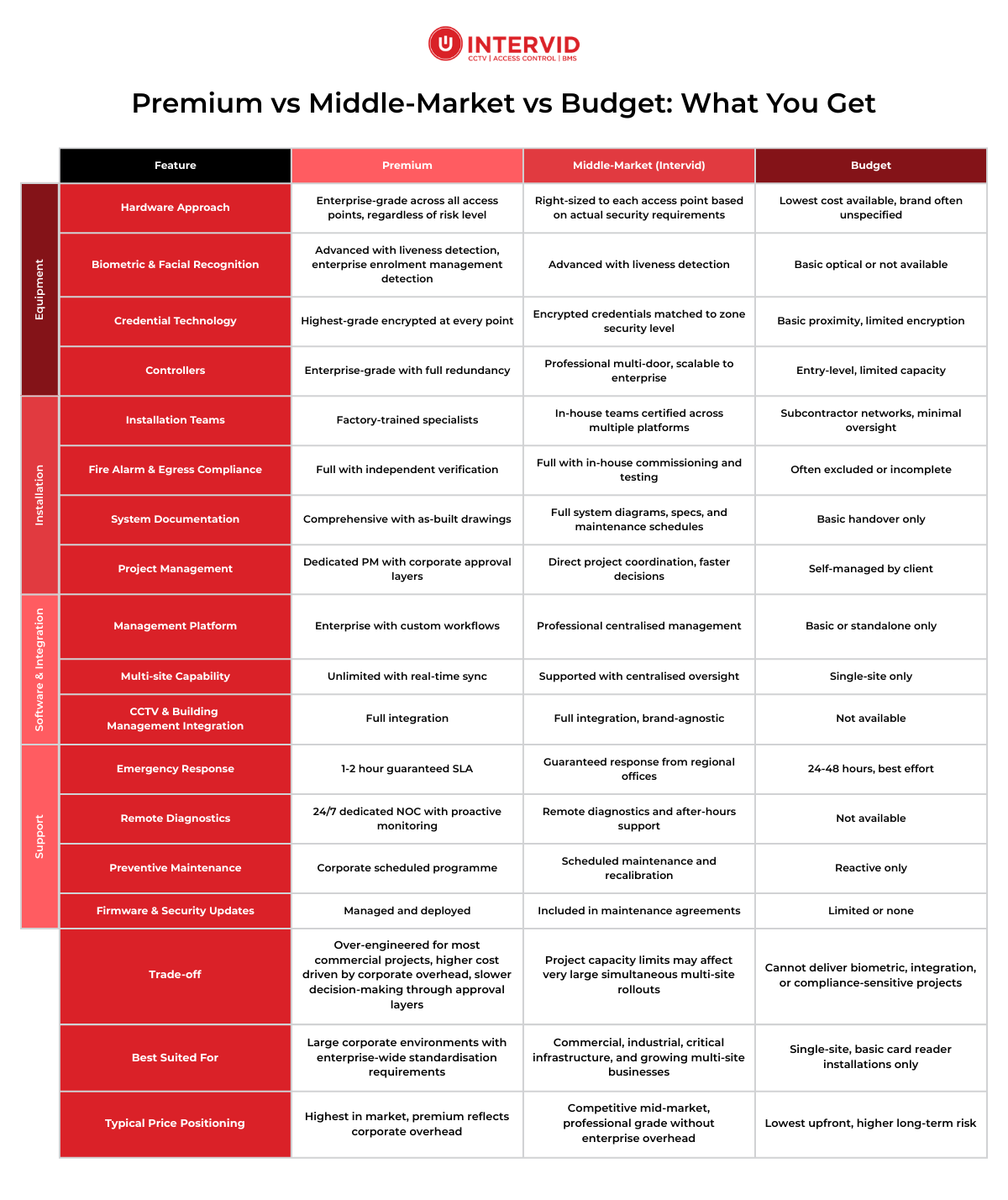
Different business models among access control suppliers create significant variations in pricing, service delivery, and long-term support.
A premium provider’s comprehensive approach differs fundamentally from a budget supplier’s streamlined operations, affecting everything from system design to ongoing maintenance.
This chapter examines three primary provider models and how each impacts pricing, quality, and long-term value for your specific requirements.
Before evaluating providers, understand that commercial access control projects fall into two distinct categories requiring different expertise levels.
Straightforward projects involving card readers, basic door hardware, and simple network configurations for standard commercial environments.
These installations require competent technical skills but don’t demand specialised integration knowledge. Most suppliers compete in this space, making it price-driven with limited differentiation.
Complex projects combining biometric authentication, facial recognition, CCTV coordination, perimeter security, and building management integration.
These require deep technical expertise, manufacturer certifications, and multi-system orchestration that only a small percentage of providers can deliver. Understanding which category your project falls into helps identify providers with the right capabilities.
Premium providers operate through manufacturer-certified installation teams with dedicated project managers overseeing deployments from design through commissioning.
They maintain comprehensive service agreements with guaranteed response times, in-house integration specialists, and 24/7 support infrastructure.
This suits organisations with complex multi-site requirements, biometric deployments, or extensive integration needs where technical expertise directly impacts project success.
However, the comprehensive approach increases costs and corporate decision-making processes, which can extend timelines. Premium providers may also apply enterprise-grade solutions to basic requirements, over-engineering straightforward installations where simpler systems would perform equally well.
Organisations with standard card reader projects and internal technical capabilities may find premium services unnecessarily expensive for their actual security needs.
Legitimate budget providers achieve lower pricing through streamlined operations, volume purchasing, and simplified service models focused on standard installations and basic warranties.
They typically operate exclusively in the standard project market, handling straightforward deployments that don’t require integration expertise or compliance-sensitive installation work.
However, risky budget suppliers compromise quality through minimal supervision of subcontractors, corner-cutting installation practices that skip proper testing, and limited local support infrastructure.
Equipment substitution during installation, where quoted brands are replaced with inferior alternatives, is a particular risk in access control, where reader and controller quality directly affects daily security performance.
Budget suppliers can deliver adequate results for simple card reader installations. The risk increases sharply when projects involve biometric systems, fire alarm integration, or multi-system coordination that exceeds their technical capabilities.
Cheap quotes typically conceal compromises that surface during implementation or operation.
Software licensing is the most common surprise.
Systems priced attractively for small user counts become expensive as organisations grow through tiered per-user fees. Annual maintenance charges, biometric database licensing, integration API fees, and mobile credential subscriptions often appear as separate line items after the hardware contract is signed.
Integration limitations create further hidden costs.
Systems that can’t connect to existing CCTV, HR, or building management platforms force manual workarounds or expensive replacements. Proprietary protocols lock you into a single vendor without competitive alternatives for future expansion.
Budget hardware savings diminish quickly when underperforming equipment needs replacement.
Readers that fail in outdoor conditions, controllers that can’t support user growth, and systems lacking proper credential encryption all require costly upgrades that exceed the original price difference.
Installation quality is equally critical.
Non-compliant door hardware, missing fire alarm integration, or incorrect lock configurations create remediation costs and potential liability that far exceed what a proper installation would have cost initially.
A single failed building inspection can generate expenses that dwarf the savings from choosing the cheapest quote.
Middle-market providers balance technical capability with cost-effectiveness, delivering professional implementations without premium corporate overhead.
Manufacturer certifications across multiple platforms, such as Paxton, HID, Suprema, ZKTeco, and Hikvision, validate technical competency and ensure warranty compliance. Experienced in-house teams handle both standard card reader installations and complex biometric or integrated deployments without subcontractor coordination delays.
Their value is most apparent on projects that sit between straightforward and enterprise-grade.
Integration with CCTV, alarm systems, and building management requires multi-discipline expertise that budget providers lack, but doesn’t necessarily demand the full infrastructure of a premium provider.
Brand-agnostic equipment selection means recommendations are based on your application requirements rather than supplier agreements. Flexible service models let you choose appropriate support levels without paying for coverage you don’t need.
Intervid operates within this model through established relationships with leading manufacturers for both premium and cost-effective solutions, experienced in-house project and installation teams certified across multiple platforms, and responsive support that delivers enterprise-level service without enterprise-level overheads.
Contact our team for a detailed assessment of your unique access control requirements. We’ll help you identify the right system configuration and service level for your organisation.
The total cost of owning an access control system extends well beyond the initial purchase. Operational costs, technology evolution, and business growth significantly impact long-term financial returns over what is typically a 7 to 10 year system lifespan.
This chapter examines the full cost picture, including upfront expenses, ongoing costs, return on investment, and financing options to help you make an informed investment decision.
Beyond the equipment and installation costs outlined in earlier chapters, several additional upfront expenses can significantly impact your total initial investment:
These expenses can increase total project costs substantially in challenging environments, making contingency planning essential for accurate budgeting.
Ongoing expenses accumulate significantly over system lifespans. Annual maintenance contracts typically cost 10-15% of the initial investment. Credential replacement and new user provisioning represent continuous expense as employees join, leave, or lose cards.
Organisations should budget R50-R150 per user annually for credential lifecycle management.
Battery and power supply replacements occur every 3-5 years. Software licensing renewals, security patches, and periodic hardware replacements to maintain compatibility with evolving technology create predictable recurring costs.
A quality system costing R1 million might incur R150,000 in maintenance and operational costs over ten years, totalling R1.15 million.
A cheaper R650,000 alternative could require R400,000 in premature replacements, additional maintenance, and operational disruption, reaching R1.05 million by year five and exceeding R1.3 million over the full lifecycle.
Budget systems often require complete replacement after 4-6 years due to component failures, obsolete software, or security vulnerabilities that manufacturers no longer patch. Quality installations typically operate reliably for 8-15 years with routine maintenance.
Factor in operational disruption during system downtime, emergency repair premiums, and the administrative burden of managing unreliable equipment when evaluating actual ownership costs.
Organisations increasingly prefer planned maintenance cycles over waiting for failures to force action. Scheduled reader cleaning, battery monitoring, and biometric recalibration prevent performance issues before users experience them.
Allocating 10-15% annually for strategic maintenance and component refresh prevents the costly disruptions and security gaps that come with reactive replacement after equipment fails.
ROI calculations demonstrate value beyond simple cost recovery.
Reduced security staffing provides the most measurable return. Organisations replacing a manned checkpoint with automated access control save R180,000-R300,000 annually per guard position, often recovering system investment within two to three years.
Key management elimination saves R8,000-R25,000 per rekeying event. Access control credentials deactivate instantly when staff leave, removing the cost and security risk of physical key management entirely.
Time and attendance integration eliminates manual timesheet processing, reducing administrative overhead by 60-80% in organisations with over 100 employees.
Insurance premium reductions of 10-25% reward improved security infrastructure. Compliance and audit trail automation satisfy regulatory requirements that would otherwise demand manual documentation. A single prevented security incident often exceeds the entire system cost.
However, ROI calculations should account for operational costs and realistic timelines. Conservative estimates help justify investments without creating unrealistic expectations.
Commercial financing alternatives help spread access control costs while preserving working capital.
Capital purchases offer tax depreciation benefits and provide the best long-term value for organisations with available cash reserves. Outright ownership eliminates interest charges and often secures 5-10% supplier discounts. The trade-off is concentrated financial impact in a single budget period.
Operating leases convert large capital expenditure into predictable monthly payments, preserving cash flow for core operations. Lease terms typically span 3-5 years with technology refresh options. However, total payments exceed purchase prices over the lease term. This suits organisations prioritising cash flow over total cost.
Equipment financing spreads costs over 3-7 year terms while building asset ownership. Interest rates typically range from 8-15% depending on creditworthiness. Many suppliers partner with financing companies to streamline approvals and offer promotional rates.
Leasing preserves cash but costs more over time. Financing creates fixed monthly obligations but builds asset value. Cash purchases eliminate interest but strain immediate liquidity.
Consider your organisation’s cash flow requirements, tax situation, and equipment replacement cycles when evaluating options. The lowest monthly payment doesn’t always represent the best long-term value.
Intervid offers flexible financing options that minimise upfront investment while providing access to professional security technology. Contact us to discuss financing terms for your access control system.

Smart access control system decisions are based on three core principles highlighted throughout this guide.
The lowest quote can lead to higher costs later, due to subpar equipment, installation issues, or lack of ongoing support. On the other hand, premium providers may be overkill for simpler projects. Aim for a balance between system quality, service level, and total cost of ownership.
Next steps:
For a more comprehensive understanding of security system costs, be sure to explore our guide on CCTV system pricing as well.
Contact Intervid today for a tailored consultation and site assessment.

The best access control system depends on your security risk profile, operational requirements, and budget.
Standalone card or keypad systems suit small businesses needing basic entry control at a limited number of doors, while network-based systems are ideal for organisations that require centralised management, audit trails, and the ability to scale across multiple access points or sites.
Biometric and facial recognition systems are best suited to high-security or regulated environments where identity verification, compliance reporting, and credential misuse prevention are critical.
Key considerations include the type of access points you are securing, the level of audit and compliance required, integration with CCTV or building management systems, and how frequently access permissions change.
Intervid helps businesses select the right access control solution through detailed site assessments that align system design with real operational needs.
We work with trusted manufacturers across card, biometric, and integrated platforms to ensure each access point uses the appropriate level of technology without unnecessary cost.
Contact Intervid for a tailored access control assessment and system recommendation aligned to your security objectives and budget.
There is no one-size-fits-all brand for commercial access control. The best option varies based on your unique needs, budget, and technical setup.
Access Control System Manufacturers:
For facial recognition integrated with CCTV systems, Hikvision and Dahua offer advanced AI-powered cameras that seamlessly coordinate with access control.
Brand selection should align with your application requirements. Intervid partners with multiple manufacturers to match equipment specifications to specific needs rather than defaulting to single-brand solutions. Our brand-agnostic approach ensures optimal technology for each area.
Contact us to discuss which brands best suit your requirements.
Biometric access control prices in South Africa typically range from R2,500 to R50,000 or more per access point, depending on the authentication technology, hardware quality, and installation requirements.
Basic fingerprint readers sit at the lower end of the range and suit standard commercial environments where identity verification is needed but throughput demands are modest. Mid-range systems using facial recognition with anti-spoofing capabilities are more common in corporate and industrial settings, while advanced multi-factor configurations combining biometrics with card or PIN authentication command the highest pricing.
Several factors push the costs of biometric access control higher. Outdoor installations require weatherproof enclosures rated to IP65 or above, adding 20 to 35% to reader costs. Large user populations require enterprise-grade controllers and expanded software licensing. Regulated industries often require POPIA-compliant biometric template storage and detailed audit-trail functionality, which adds to both hardware and software costs.
Beyond the per-access-point price, budget for user enrolment during implementation, which scales with workforce size, and ongoing template management to maintain recognition accuracy over time.
For most commercial applications, biometric access control is not necessary at every door. Matching the technology to the actual risk at each access point, reserving biometric verification for high-security areas like server rooms, pharmaceutical storage, or data centres, delivers the best balance of security and cost.
Contact Intervid for a site assessment and accurate pricing for biometric access control at your facility.
Facial recognition access control prices in South Africa typically range from R8,000 to R50,000 or more per access point, sitting at the higher end of the broader biometric category.
The main cost drivers beyond basic hardware are throughput requirements, environment, and integration scope. High-traffic entrances like lobbies and turnstiles require faster processing, which pushes hardware specs and pricing up.
Outdoor installations require cameras with strong IR performance to handle variable lighting conditions. When facial recognition is integrated with existing CCTV infrastructure, costs can be offset by the camera serving dual access-control and surveillance functions.
Facial recognition suits high-traffic entrances where contactless authentication improves flow, and high-security environments where advanced identity verification is a priority.
Contact Intervid for accurate pricing for facial recognition access control based on your specific access points and requirements.
Think others may find this helpful? Share this post on your socials:
Stay informed with our latest insights, expert tips, and industry trends. Explore our related articles below:

BACK TO BLOG Access control quotes in South Africa can vary…

BACK TO BLOG Businesses and procurement teams regularly see proposals ranging…

As times change and the world becomes a fast paced, multitasking…

A CCTV Surveillance System is only as good as the cameras…

Intervid-Africa is a leading Southern African CCTV and Access Control systems…
Fill in the form below to request a quote
